
.png)
We don't retrieve the source like typical AI systems. We build it.
Travel planning is increasingly moving to AI. Last summer 55% of Americans used an AI app like ChatGPT to plan a trip, up from 38% the year before, according to McKinsey.
Yet most travel brands are publishing more content than ever, and most of it underperforms. It struggles to get indexed by Google, it rarely gets cited by AI assistants like ChatGPT or Gemini, and it too often reads as flat and generic, without the spark that moves a visitor to book.
The reason traces back to how most of that content is now produced, increasingly with AI. Obvlo approaches content creation differently, working from the ground up to produce a unique destination content database from which high performing pages are produced.
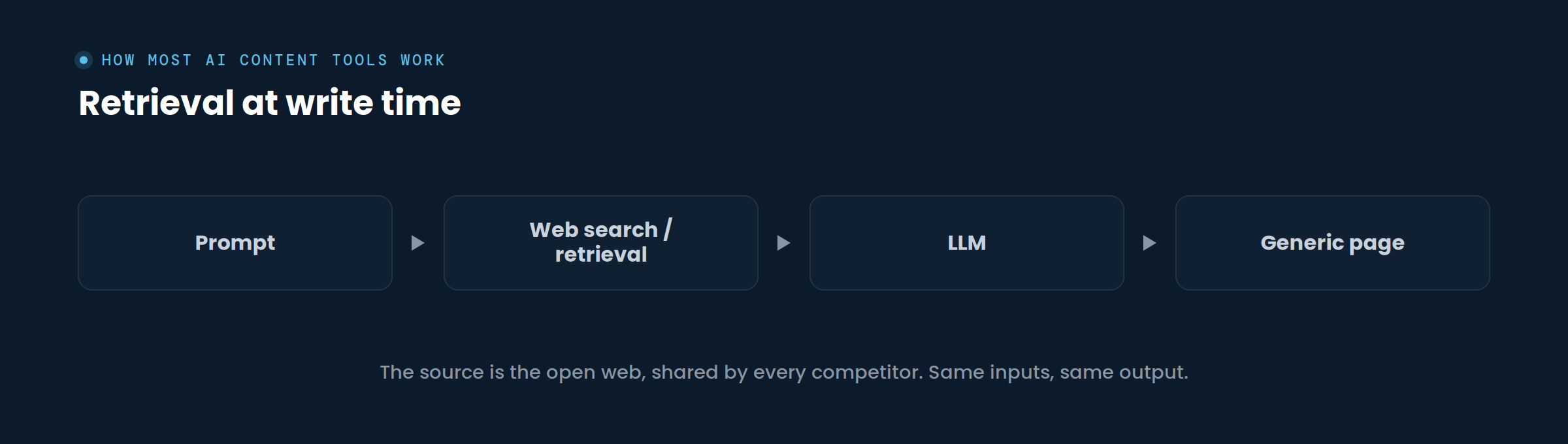
The typical approach: retrieval at write time
Most AI content tools generate a page the moment you ask for one. The model takes a prompt, reaches out to the open web through retrieval or a search tool, pulls back whatever it finds, and writes. It is fast and it scales. But the source is the open web that every competitor is drawing from too. Same inputs, same output. The pages that come out are generic, they rarely index well, and they rarely get cited by the assistants that now sit between travellers and their decisions.
For a hotel group or a destination trying to stand out, that is the whole problem in one sentence. If your content is assembled from the same public sources as everyone else's, there is nothing for an AI assistant to prefer about it.
The Obvlo approach: build the source first
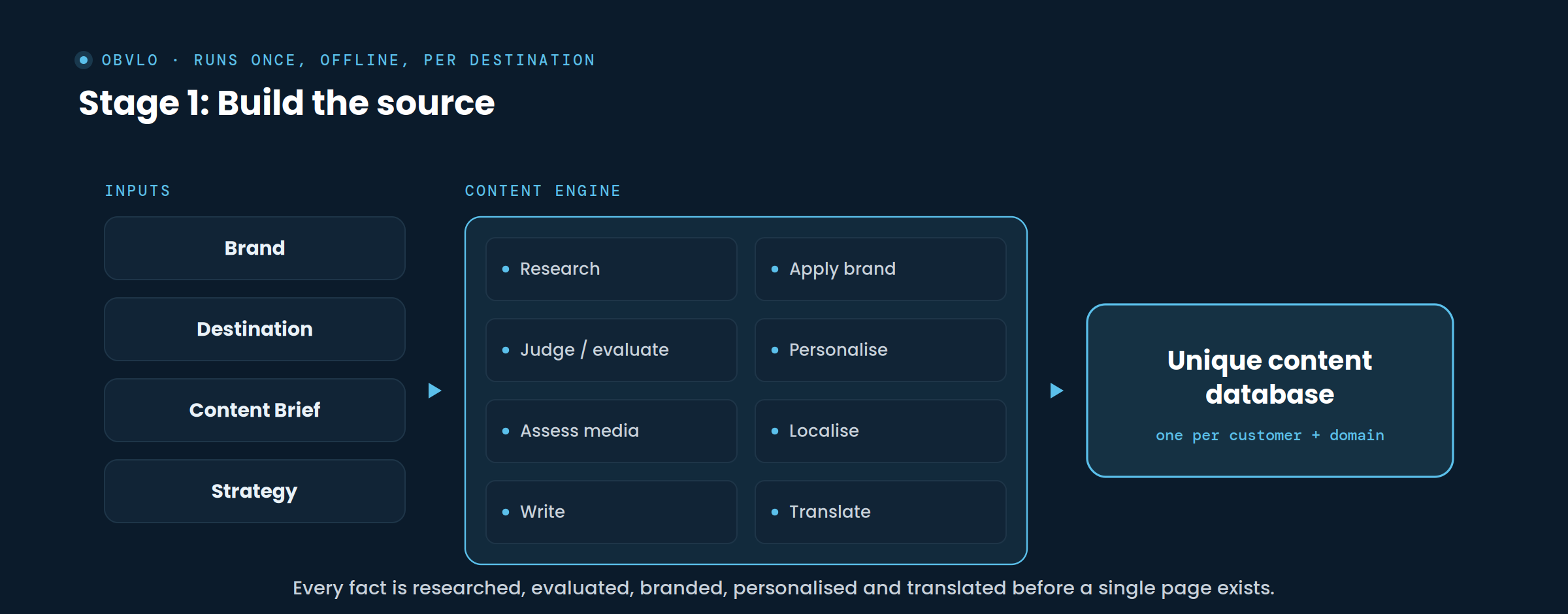
Obvlo works in the opposite order. Before a single page exists, we build a content database for that specific customer, destination and domain. Research, evaluation, brand voice, personalisation and translation all happen up front, at the level of individual facts, rather than at the moment a page is written.
We call this Stage 1: build the source. A content engine orchestrates a sequence of agentic steps: research the destination, judge and evaluate what is genuinely worth including, assess the media, write, apply the customer's brand, personalise, localise and translate. What comes out is a curated database that belongs to one customer. Every fact in it has already been checked, shaped and branded.
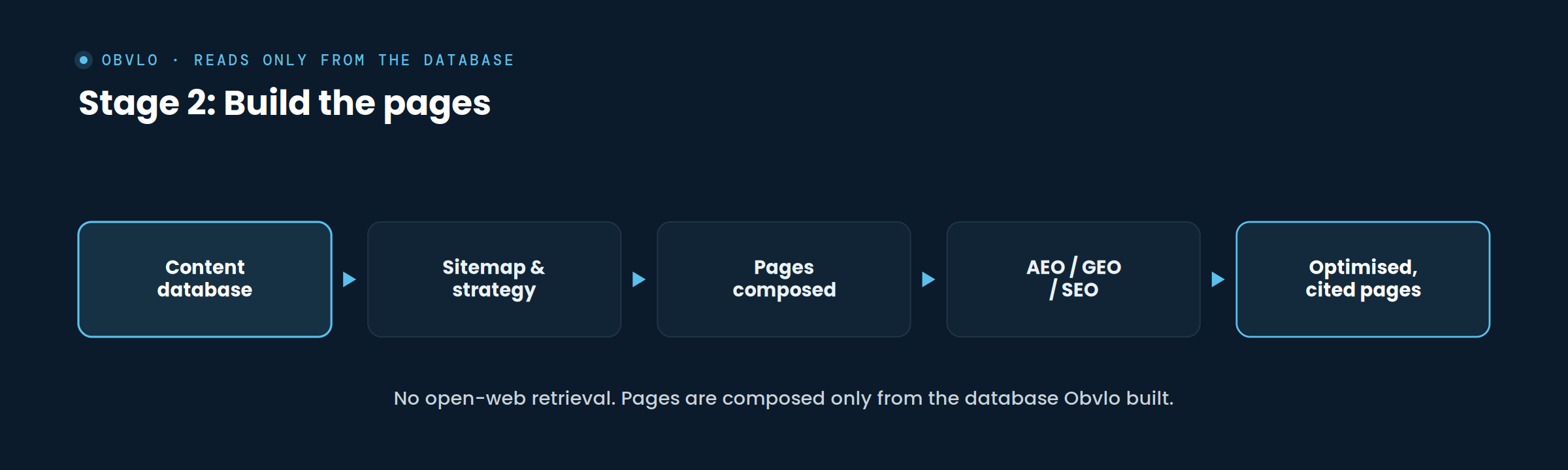
Then Stage 2: build the pages. This stage reads only from the database above. It takes the customer's domain and strategy, builds a sitemap, and composes each page from the pre-built database, optimised for AEO, GEO and SEO. Because the pages draw from a source no competitor has, they cannot collapse into the same generic output.
Why this matters for AI visibility
Getting cited by an AI assistant works slightly differently from ranking on a page of blue links, however building origonal pages that get indexed is important as a starting point. AI assistants favour content that is specific, well structured, and clearly authoritative about a place. Content stitched together from shared public sources at write time struggles on all three counts. Content composed from a researched, evaluated, branded database has a real claim to each.
The database approach also gives you control. Brand voice is applied to the facts themselves, so it holds across every page instead of being bolted on at the end. Localisation and translation are handled at the source, so a destination reads naturally in every market you sell into. And because Stage 2 only ever reads from an approved database, you always know what your pages can and cannot say.
Once we have built you a unique content database, we can use that database to build pages that are hosted on your primary domain. The next step is scaling the apporach to cover all relevant keywords, questions and quiries, in every languages your audience speaks.
The results speak for themselves
Here is what Point A Hotels, a 12-hotel city-centre group across the UK and Ireland, saw in its first twelve weeks working with Obvlo.
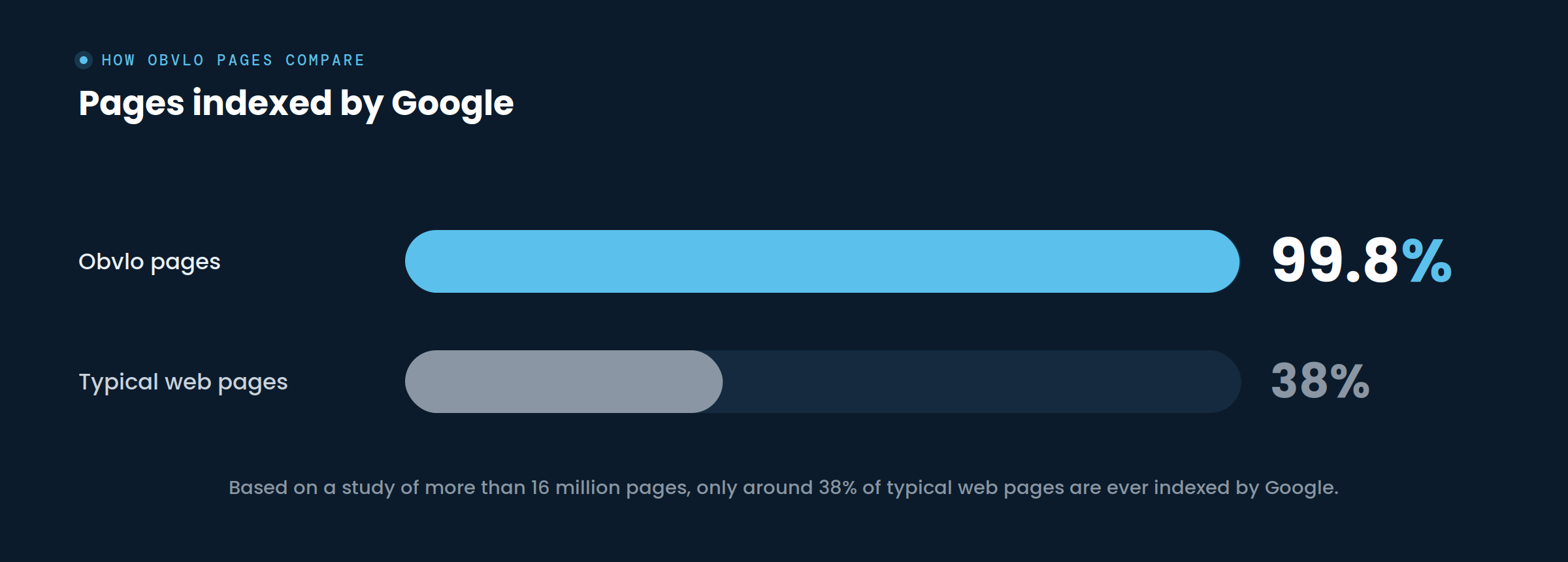
- ~4,600 new destination pages published, with 99.8% indexed in Google.
- Over 1.2 million Google search impressions for Obvlo-powered guides.
- 72x more clicks from Google search than the pre-existing blog.
- Over 35,000 generative AI impressions, with citations in Google's AI Overview and referrals from Gemini, ChatGPT, Copilot and Perplexity.
- Content published in thirteen languages, with 42% of landing-page sessions from non-English readers, and pages appearing in searches from 206 countries.
Unique content, unique result for two hotels on the same street
The clearest way to see the difference is this. Two hotels on the same street get two different databases. Different brand, different guest, different strategy, and therefore different source material and different pages. A system that retrieves from the open web would hand them near-identical content, because it is reading from the same place. Obvlo cannot, because the source itself is unique to each.
That is what we mean when we say we don't retrieve the source, we build it. The database is the product. The pages are what you see. Visibility, traffic, engagement and conversions are the outcomes you get.
Get in touch
To find out about growing your travel brand with a destination content strategy, get in touch here.