
.png)
How do you influence destination choice when travellers stop visiting your website?
When we ask destination leaders what's keeping them up at night, the answer is always in the numbers: traffic is disappearing. Organic search, the reliable channel that fueled the destination website for the last decade is going away, and everyone knows where it's gone.
Travellers are using AI assistants like ChatGPT, Gemini and Perplexity to discover destinations, weigh them up and plan trips, getting their answers before they ever reach your site.
51% of DMOs report being concerned about AI-driven search disruption, though far fewer are prepared for it. You can see that traffic is going away, but not how you appear inside the AI answers. So the obvious move is to go looking and buy an AI visibility monitoring tool.
Soon the numbers arrive, confirming what you already suspected. Months later the dashboard is optimised, but the number still hasn't moved, because watching it was never going to move it. Monitoring measures the gap, but can’t close it. At this point, the real problem becomes apparent and it turns out to be much larger than the one you set out to solve.
Losing traffic to AI is only a symptom. The dashboard confirmed that you are absent from the answers, but your absence from the answer is really absence from the decision. The place where travellers choose a destination is moving off your website and into a conversation with an AI assistant. Any influence you have over that decision is going away with it.
The decision is moving away from websites
For a decade the journey was predictable. A traveller searched on Google, found your destination content, arrived on your site, and moved onward to hotels, attractions, venues, local partners and members. The website was the place where consideration happened, and traffic, referrals and conversions were a fair way to show you had shaped it.
A traveller can now ask an AI assistant for recommendations on where to go, compare two or more destinations on the criteria they care about, assemble a day-by-day itinerary and settle most of the decision before any official destination source enters the picture. The research, the comparison and the shortlist all happen inside the answer. Your destination can be showcased there, recommended, ruled out, and none of it registers as a visit to your website.
The information a DMO holds should still be shaping a visitor’s decision. Whether it does now depends on something the organisation has never had to think about: whether the systems mediating the choice can find, understand and trust the destination's knowledge well enough to cite it.

What earns you a place in the AI answer
To be cited by these systems, information has to be readable to them. They assemble an answer from sources they can read, trust and lift a clear, specific fact from: the neighbourhoods, the seasons, the prices, the "best for" distinctions a real question surfaces.
Most destination content was built for a different purpose, to inspire an actual person browsing a homepage, so it leans on mood and adjective rather than structure and fact. To an AI system that material is close to invisible, competing with roughly 7.5 million blog posts published every day and offering nothing precise enough to quote with confidence.
Only around 31% of DMOs expect their own website to become the source of truth for AI answers about their destination. The rest are leaving the answers to someone else, like a review aggregator, a rival operator, an old article. When a traveller asks where to spend five days in your region with children in October, someone is going to provide the answer, but for most DMOs, it is not them.
From scattered knowledge to a single source of truth for AI
.png)
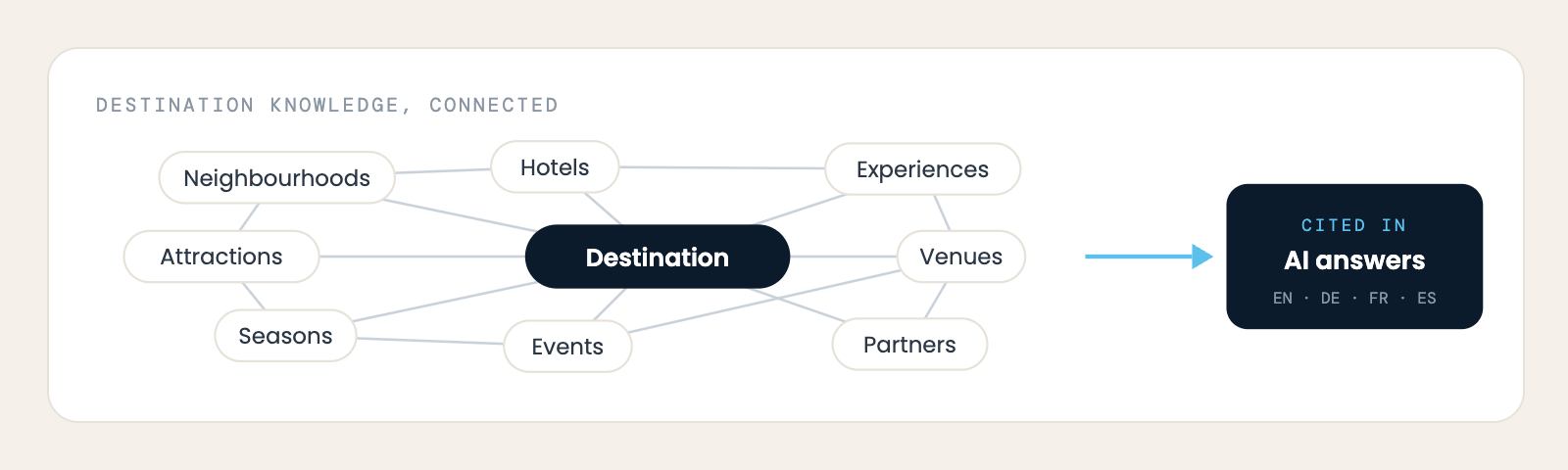
Most destinations are not short of local knowledge. It already exists in local experts, hotels, attractions, venues, event organisers, neighbourhoods and visitor services. The trouble is that it is scattered, across partner pages, campaign microsites, PDFs, databases and individual teams, most of it created to win a click or serve a campaign rather than to establish the destination as a source an AI system can rely on.
The work is one of both organisation and scale: turning that dispersed knowledge into a coherent, authoritative, machine-readable body of destination intelligence. Deep, specific, structured, kept current, and clear about what the destination offers, who it suits, what makes it distinctive and how its places, experiences and partners connect.
That is a production and organisation challenge at a scale a small, budget-constrained in-house team cannot meet by hand, and it grows again once you account for the global nature of AI adoption. In the US, 56% of travellers now use AI to plan, book or navigate a trip, and standalone AI platforms are already the top planning entry point for 51% of Germans, 48% of the French and 44% of UK travellers.
Those travellers are making the same decisions through the same engines, in their own languages, drawing on content written in those languages. A destination that is authoritative in English and absent everywhere else is influential in a shrinking share of the choices that matter. Coverage across multiple languages is where much of your future demand already sits.
This is the point where hand-production stops being realistic and a content engine becomes essential. It is the problem Obvlo was built to solve: turning a destination's fragmented knowledge into structured, authoritative content that AI systems can understand and cite, at depth and in multiple languages, at a scale a human team can direct but could never write, localise or publish alone.
Proving influence without measuring clicks
For years, sessions, referral traffic and campaign conversions have explained the DMO's contribution to boards, funders, partners and members. In an AI-mediated journey, influence happens without a click. Your destination can sit inside an itinerary, a recommendation or a comparison while the traveller never appears in your analytics. The dashboard that you previously used to demonstrate your value can no longer answer the question that matters above all others: are we meaningfully influencing destination choice?
New AI visibility measures help, but they cannot simply be bolted onto the old dashboard and treated as one more marketing metric. Citation frequency and share of voice in AI answers mean little on their own. They have to be connected to destination relevance, visitor intent, partner value and the wider economic outcomes a DMO exists to drive. That means treating AI visibility as a leading indicator of consideration and tying it back to arrivals, partner bookings and spend, the outcomes the board already cares about.
This is a strategic priority, not a marketing project
The instinct we have seen play out with DMOs we have been speaking to is to route this to the SEO or content team and ask for a plan. But that is a mistake. A project has an owner, a budget and an end date; this priority requires the destination's knowledge to become a permanent, organisation-owned asset, built and maintained over time. It stops being something the marketing team produces and becomes the very heart of what a DMO is.
If destination choice is increasingly shaped inside AI answers, then remaining influential there is close to the core purpose of the organisation. It’s not simply a channel for one team to keep an eye on. That pulls in decisions no content team can make on its own: what the destination stands for and who it is for, how partners and members contribute their knowledge and see value in return, who owns and maintains that knowledge as an asset, what the DMO now counts as success, and how it explains all of this to a board still reading last decade's metrics. These need to be part of the leadership’s agenda.
The fundamental shift
.png)
The pressure is only going to build from here. The traveller consulting an AI engine is now being joined by agentic systems that shortlist, compare and increasingly book on a traveller's behalf.
When the shortlist is drawn up by a machine reading structured knowledge, a destination it cannot understand is left off the list altogether. There is no page two to climb back from like there was with traditional search. You are either in the answer or you are not.
So the dilemma keeping you up at night was never really about traffic, and it was never going to be solved by measuring how absent you are. Measuring the gap is the easy part, and it will get sharper every quarter. Closing it means turning your destination knowledge into the authority a machine can trust, and building a new way to prove your influence and the value it creates.
The destinations that stay relevant and remain well funded through the next few years will not be the ones with the most comprehensive dashboards. They will be the ones that influenced traveller decisions and remained relevant, in every language their travellers are planning in, long after the website stopped being the place that decision was made.